
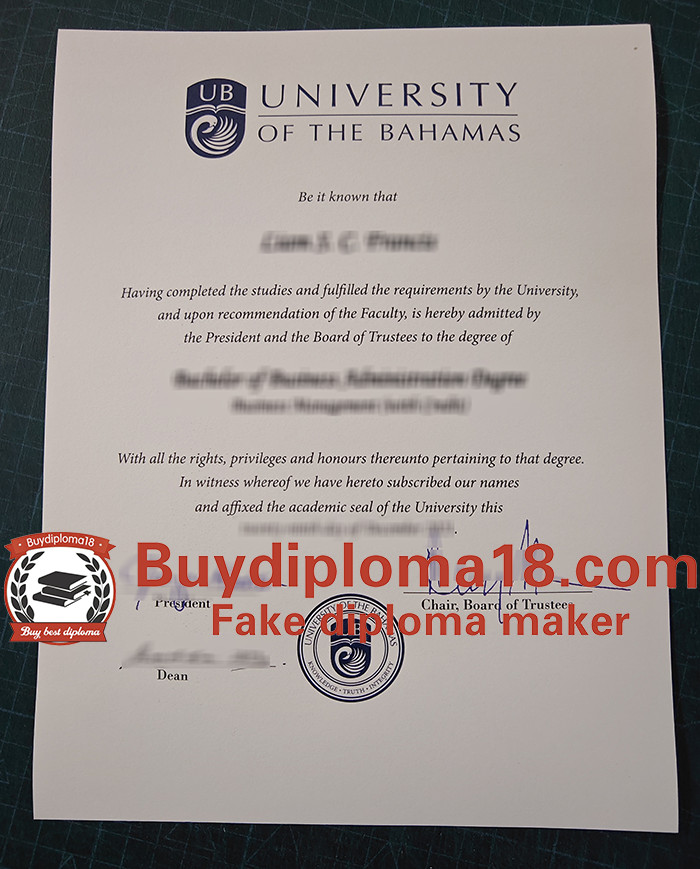
University of the Bahamas diploma
Buy fake University of the Bahamas diploma, buy fake University of the Bahamas degree certificate. Nestled among the archipelagos of the western Atlantic, degrees from the University of the Bahamas (UB) are not merely credentials of academic achievement, but also symbols of this young island nation’s pursuit of autonomous knowledge production and sustainable development. As the Bahamas’ only national institution of higher education, its diplomas embody the unique educational vision of a post-colonial, small-island developing country—to safeguard cultural identity amidst globalization, build ecological resilience in the face of climate crisis, and forge an autonomous path to development amidst great power competition.
The University of the Bahamas traces its origins back to the Bahamas College, founded in 1974. Its upgrade to a national comprehensive university in 2016 marked a crucial step for this nation, which gained independence in 1973, on its path to knowledge autonomy. Unlike many former colonies that rely on overseas education, UB represents a conscious effort towards “academic decolonization”—its curriculum and research focus are closely aligned with the realities of the Bahamas and the Caribbean. From marine resource management to island economics, from Creole studies to tourism anthropology, its degree programs are consistently imbued with a clear awareness of local issues. Earning a degree from UB signifies mastering a set of localized knowledge tools for understanding and building Bahamian society.
The most unique value of University of the Bahamas diploma lies in its in-depth academic exploration of “island life.” In the natural sciences, marine science and climate change research directly address the most pressing survival challenges of island nations, with environmental monitoring data providing crucial scientific support for the Association of Small Island Communities’ international climate negotiations. In the humanities and social sciences, oral history, indigenous arts, and intangible heritage studies bring long-marginalized island knowledge into the academic fold. Most innovative is its interdisciplinary “Island Studies” program, exploring sustainable development paths for island societies from ecological, economic, and cultural dimensions. This knowledge production, rooted in local contexts yet possessing universal significance for islands globally, makes UB a vital node in the global network of small island nation studies.
As a university located in a climate-vulnerable region, UB integrates “resilience education” into every degree program. All students are required to complete a mandatory environmental literacy course, understanding real-world issues such as sea-level rise, coral bleaching, and hurricane response. The campus itself is an ecological laboratory: its flagship campus is located on Oxkes Reef, an island severely damaged by a hurricane. The reconstruction process incorporated cutting-edge technologies such as green infrastructure, rainwater harvesting, and renewable energy, with faculty and students participating in the entire process from planning to operation. This immersive education, “learning resilience amidst vulnerability,” cultivates not only professional knowledge but also the psychological resilience and practical skills to cope with an uncertain future.
University of the Bahamas diploma represent a global South perspective. Through the CARICOM education integration framework, UB has established credit transfer and joint research with universities in Trinidad, Jamaica, Barbados, and other regions, jointly developing curriculum systems suitable for tropical island nations. Simultaneously, its “North-South cooperation” model is unique: maintaining traditional ties with universities in the US, Canada, and the UK, while actively engaging in knowledge exchange with island nations facing similar challenges, such as Singapore, Seychelles, and the Maldives. This network, rooted regionally yet oriented towards the global South, equips graduates with the crucial ability to find their own space for development in asymmetric globalization.
In the Bahamas, an archipelago nation with a population of less than 400,000, the University of the Bahamas’s “national” status imbues its degrees with a special sense of public responsibility. Over 80% of its courses are open to community auditing, and research projects prioritize the needs of local governments and civil society organizations. Nursing students provide mobile medical services in the Family Islands, the College of Education provides customized teacher training for primary and secondary schools nationwide, and the Business School assists small and micro-tourism operators in developing recovery plans. The awarding of degrees is not merely an accreditation of academic ability, but a public affirmation of a commitment to serving the nation’s development.
The weight of a University of the Bahamas degree lies not only in the proportion of graduates holding leadership positions in key sectors such as government, education, and tourism, but also in its symbolism of a small island nation’s firm assertion of intellectual sovereignty. In today’s world, where climate change threatens island survival and global tourism patterns reshape cultural ecology, this diploma represents a systematically trained ability: maintaining cultural awareness amidst openness, cultivating ecological wisdom amidst vulnerability, and forging an autonomous path amidst dependence. It is not a passport to escape the islands, but a wise blueprint for building a home—this is the most precious gift the University of the Bahamas offers to this nation.
Reviews
There are no reviews yet.